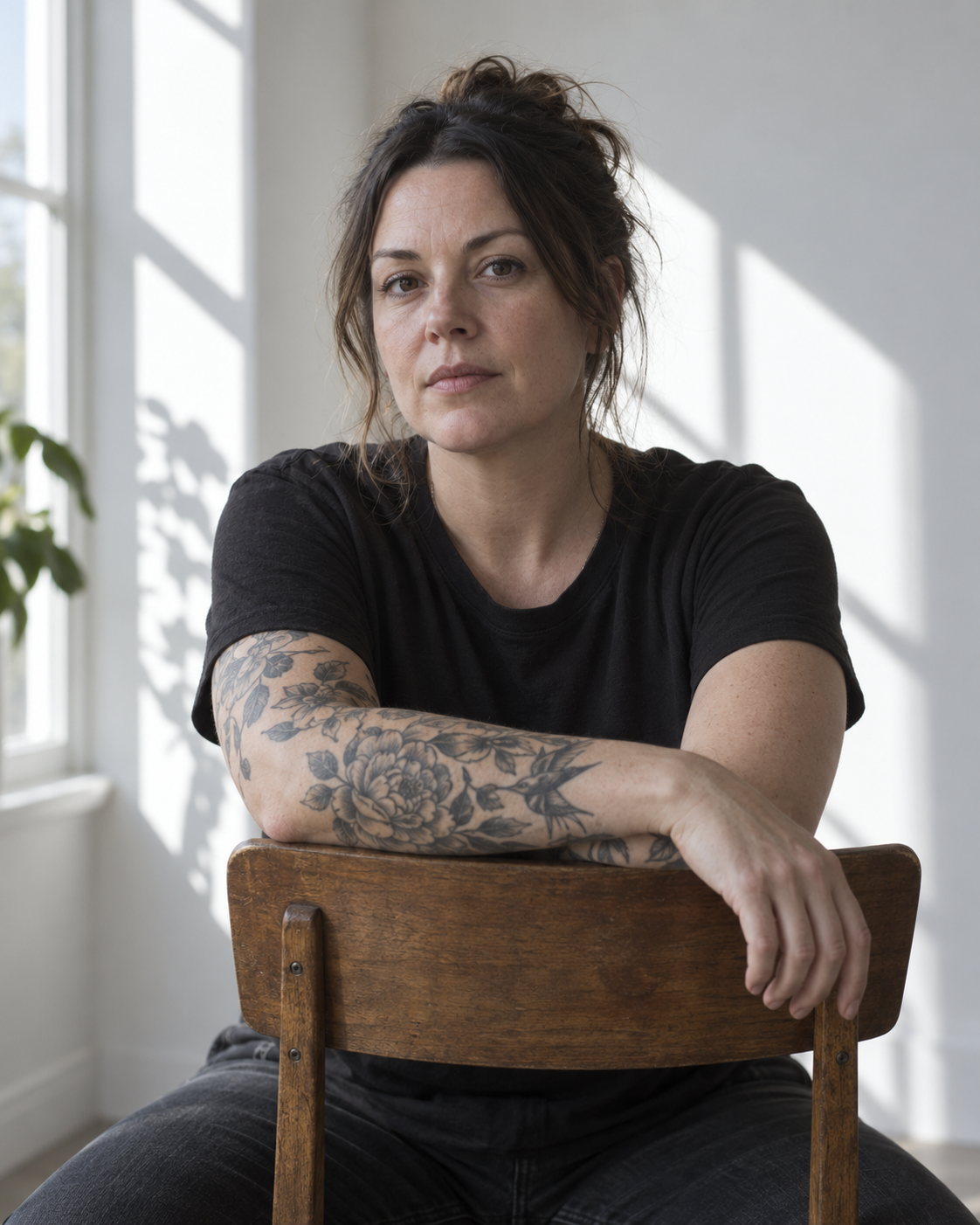
“The design conversation was the first time anyone asked me what I actually wanted it to look like.”
Alana's bilateral planning at the Miami center ran over three months, which she says was longer than she expected and exactly as long as she needed. Her clinical evaluation established the pathway quickly; the design conversation took considerably longer, because what she wanted was a matched engraved pair and matched engraving is where most commissions fail.
Her Design Specialist worked through profile, symmetry, material and finish in stages rather than all at once, and Alana was shown how each decision constrained the next. A deeper engraving meant a thicker plate; a thicker plate meant a different profile; a different profile changed what the engraving would read like at arm's length. She describes reversing her own preference twice — from a defined profile to a low one, and from silver back to steel — without anyone treating it as indecision.
She tattoos for a living, which she thinks made the process easier and harder in roughly equal measure. “I know what it is to be handed a drawing by somebody who has not thought about the surface it is going on,” she says. “So I was probably a nightmare. They did not treat me like one.”
The written plan she took home listed every choice and the reason for it, including the two she reversed. She used it to explain the decision to her family, who had been anxious about it, and says the documentation did more to settle those conversations than anything she could have said herself.
Individual results and experiences vary. Accounts are published with the participant’s permission, reviewed with them before publication and withdrawn at their request. Names appear as a first name and last initial.